

"Sulfate-free shampoo" is one of the most searched terms in haircare. Yet there's a lot of confusion around it: some people see it as a miracle solution, others dismiss it as marketing. Let's set the record straight — what sulfates are, who genuinely needs a sulfate-free formula, who doesn't, and how to avoid disappointment when making the switch.

What Sulfates Are and Why They're in Shampoo
Sulfates are a group of surfactants (surface-active agents) responsible for cleansing and lathering. The most common ones are:
- SLS (Sodium Lauryl Sulfate) — the harshest and cheapest, produces a rich lather.
- SLES (Sodium Laureth Sulfate) — gentler than SLS, but still quite stripping.
Sulfates are excellent at dissolving grease and dirt — that's their strength. The problem is that along with the grime, they also strip away the scalp's and hair's natural protective lipid barrier. For strong, normal hair this isn't critical. But for dry, damaged, color-treated hair or a sensitive scalp, it's unnecessary stress.
This isn't a matter of preference: Sodium Lauryl Sulfate (SLS) is so reliably irritating to skin that dermatology uses it as a "standard irritant" — when a study needs to deliberately provoke a skin reaction, SLS is the go-to. For a deeper breakdown, see our dedicated article on sulfates.
Sulfate-Free Doesn't Mean It Won't Cleanse
The biggest myth: "without sulfates, a shampoo can't clean properly." In reality, sulfate-free formulas use other, milder surfactants:
- Coco-glucoside, decyl glucoside — gentle surfactants derived from coconut and sugars.
- Cocamidopropyl betaine — a mild co-surfactant.
- Sulfosuccinates, isethionates — deliver gentle yet effective cleansing.
They cleanse a little differently: there's less lather and no "squeaky-clean" sensation — and that's perfectly fine. That "squeak" is actually a sign of an over-dried scalp, not a sign of cleanliness.
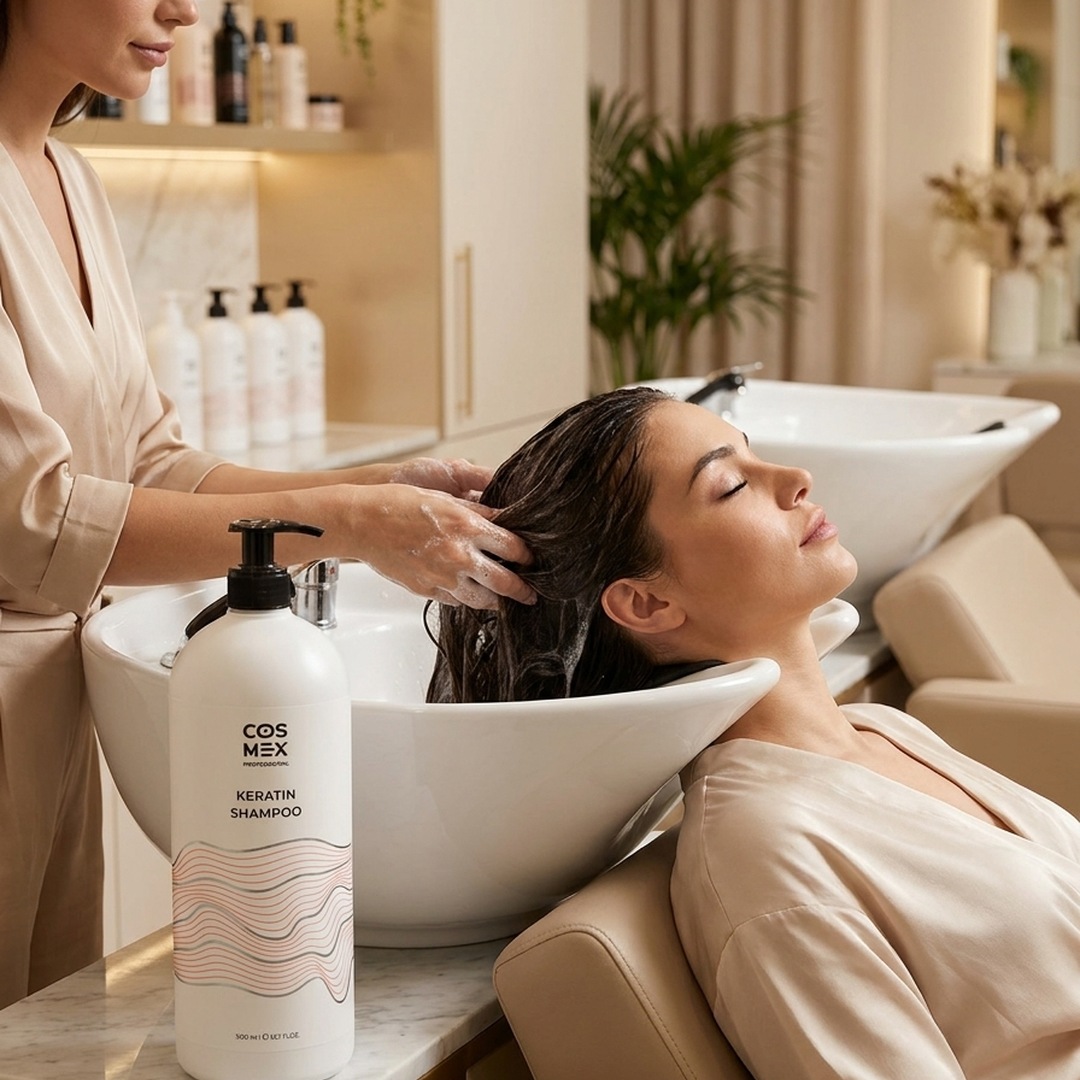
Who Actually Needs a Sulfate-Free Shampoo
A sulfate-free formula is especially worth it if you have:
- dry, brittle, or damaged hair;
- color-treated or bleached hair — milder surfactants fade color more slowly;
- a sensitive scalp prone to irritation;
- oily roots with a "rebound effect" — where frequent harsh washing makes hair grease up even faster;
- a keratin straightening treatment or botox treatment — sulfates quickly break down the effect.
Who doesn't need to switch: if your hair is strong, uncolored, your scalp is calm, and your current shampoo works perfectly for you — there's no reason to switch just because it's trendy. Honest haircare is about addressing a real need, not chasing a label.
What to Expect During the Transition
For the first 2–4 weeks, your hair may behave differently — this is your scalp adjusting as it unlearns its dependence on harsh cleansing. Give it time, and don't reach for a sulfate shampoo after just one wash. Less lather is normal; apply the shampoo twice — the first application does the heavy cleansing, the second gives a thorough, gentle rinse.
Sulfate-Free Shampoos by Cosmex
The entire Cosmex Professional professional line is built on a sulfate-free, mild base — it's a core principle of the brand, not a separate "special" shelf. We formulate and produce our shampoos ourselves in Almaty, which means we can maintain honest concentrations of active ingredients without cutting corners on the base.
For every hair concern, there's a dedicated line on a sulfate-free base:
- Trichology — weakened hair and hair loss;
- Anti-Dandruff — dandruff and flaking;
- Keratin — damaged, porous hair;
- Repair — brittleness and split ends;
- Balance — oily roots;
- Hydration — dry hair;
- Collagen — volume for fine hair;
- Anti-Yellow — brassiness on blonde hair.
The philosophy is the same across all lines: cleanse gently without compromising the scalp's barrier, and target specific concerns with active ingredients. We don't resell — we manufacture, so you're paying for the formula, not someone else's brand. Browse ingredients and prices in the Professional catalog — or go straight to the sulfate-free shampoo collection, where the full range is organized by concern.


