

Dry hair looks dull, frizzy, and prone to static — it's hard to comb through and feels rough to the touch. This is especially noticeable in our continental climate, where dry frosty winters with indoor heating and hot, sunny summers drain moisture from both skin and hair almost year-round. The good news: in most cases, this isn't a life sentence or something you were simply 'born with' — it's a condition that proper care can genuinely change. Let's break it down plainly: how dry hair differs from dehydrated hair, why just 'adding oil' doesn't work, and how to bring back moisture and shine without overcomplicating things.
The Short Version
- Dry hair and dehydrated hair are not the same thing. Dry hair lacks lipids; dehydrated hair lacks water. In most cases, the problem is a mix of both.
- The core principle of moisturising is 'moisture + sealing': first deliver water using humectants, then lock it in with oils and lipids.
- Pouring straight oil onto dry hair is a mistake. Oil without moisture 'seals in emptiness' — the hair looks shiny on the outside but stays dry on the inside.
- Harsh sulfates make dryness worse — a gentle sulfate-free base preserves what little the dry hair strand already has.
- Results are cumulative: smoothness and shine build up over a couple of weeks of consistent care, not after a single wash.
Now let's go deeper.
Dry vs. Dehydrated — They're Different
This might sound like splitting hairs, but it's exactly what determines which type of care will actually work for you. These are two distinct conditions, and confusing them is one of the most common reasons why a haircare routine seems to 'do nothing'.
- Dry hair. The scalp produces little sebum, meaning the hair strand simply lacks lipids. This is often a natural characteristic or something that develops with age — sebum production decreases over time. Dry hair tends to look matte, feel stiff, and lack slip.
- Dehydrated hair. Here the problem is a lack of moisture — and more specifically, the hair's inability to hold onto it. This is almost always the result of damage: bleaching and colouring, frequent heat styling, hard water, or harsh sulfates. The cuticle is raised, water escapes, and hair becomes frizzy and full of static.
In practice, purely 'dry' or purely 'dehydrated' hair is rare. Most of the time it's a combination: damaged hair both loses moisture and fails to retain lipids at the same time. That's why effective moisturising care always works on both fronts simultaneously — delivering moisture and sealing it in.
The 'Moisture + Sealing' Principle, Simply Explained
This is the single most important idea in this article, so let me use an everyday analogy. Picture a wet towel left out in the heat: if you just leave it in the sun, it dries out in minutes. But if you cover it with a layer of cling film, the moisture stays inside for much longer.
The same logic applies to hair:
- Moisture first. You need to deliver water into the hair strand along with 'magnets' for it — ingredients that attract and hold moisture.
- Then seal it. On top of that, you apply lipids and oils — they smooth the cuticle and prevent moisture from evaporating.
If you skip this order and apply only oil to dry hair, you seal in emptiness. The surface looks shiny, but the inside remains just as dry. The rule is simple: water first, then oil. In a well-formulated product, this is already built in — the ingredients are chosen to work in the right sequence, so you don't have to layer things manually.
What Actually Moisturises Hair
Effective moisturising isn't one magic ingredient — it's a well-coordinated system. Here's a breakdown of the roles, using examples of ingredients commonly found in haircare across the industry:
- Humectants (moisture-attracting ingredients) — glycerin, aloe, Panthenol, honey, hyaluronic acid. These are the 'water magnets': they draw moisture in and keep it inside the hair shaft.
- Lipids and oils — squalane, plant-based oils, ceramides. They seal moisture inside and smooth the cuticle, which is why hair becomes glossy and sleek.
- Amino acids and proteins in moderate amounts — support elasticity, so hair stays strong as well as hydrated.
- A gentle sulfate-free base. This is the foundation: aggressive surfactants strip lipids and worsen dryness, undoing everything else the routine is trying to achieve.
And that common mistake again, because it really is widespread: drowning dry hair in oil alone. Oil without moisture 'seals in emptiness' — the hair stays dehydrated on the inside even if it looks shiny on the outside. Moisture first, then lipids — and only in that order.
The Hydration Line from Cosmex
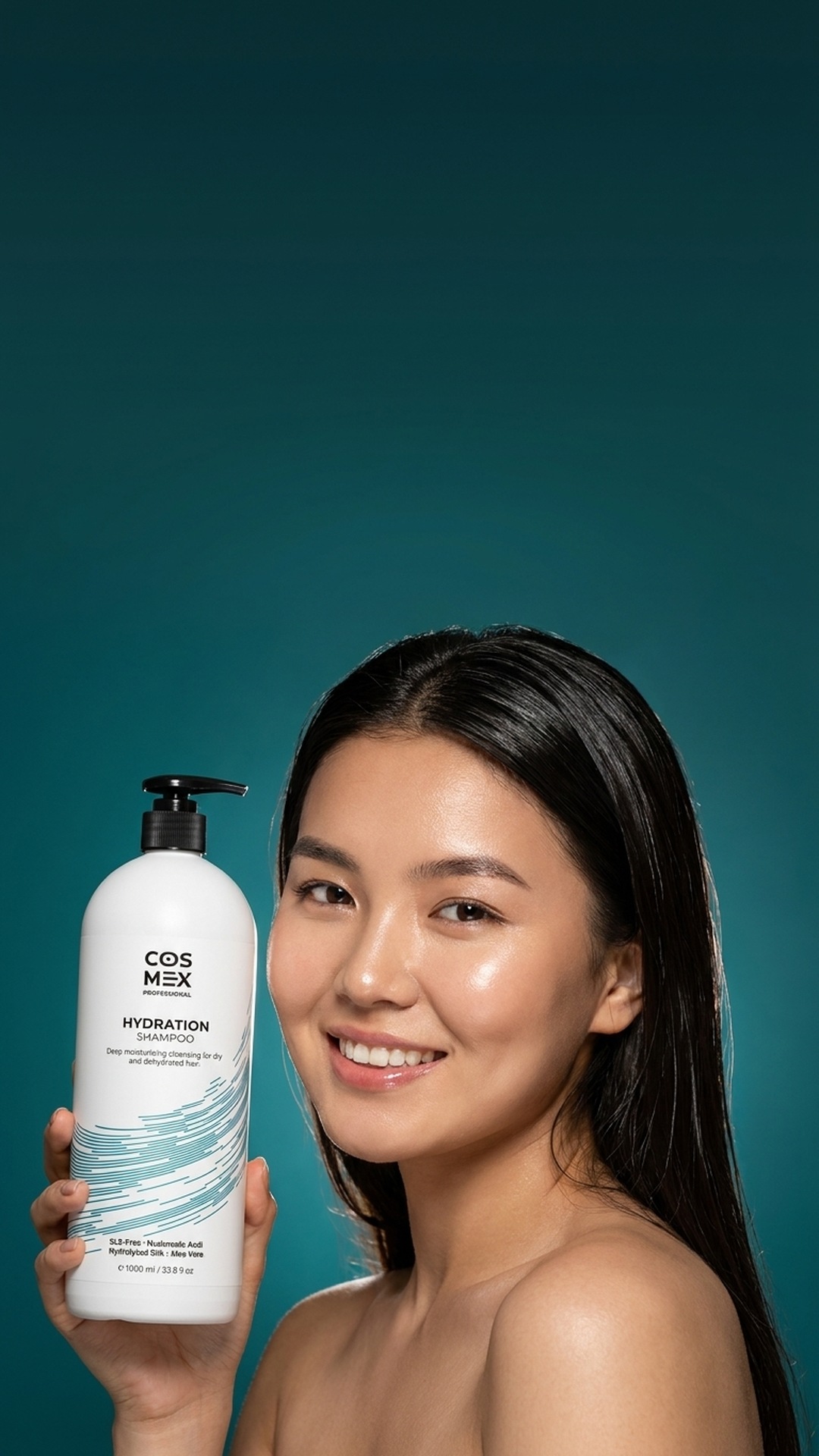
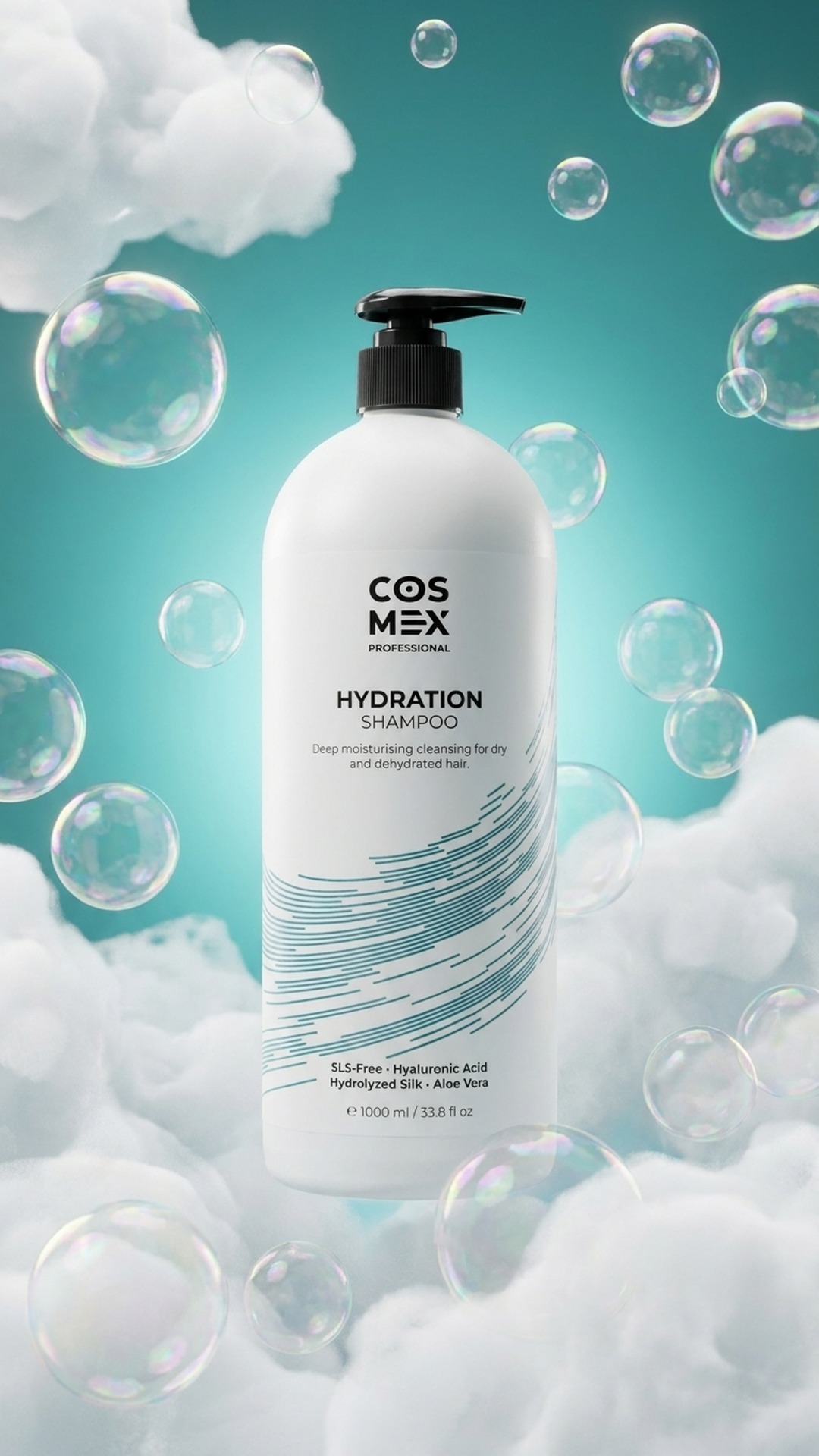
For dry and dehydrated hair, we developed the Hydration line — a sulfate-free shampoo, a moisturising conditioner, and a mask, all produced in-house in Almaty. The formula is built exactly around the principle described above — 'moisture + sealing': the heart of the line is glycerin, aloe vera juice, and hydrolysed silk, which deliver and retain moisture, while lipids seal it into the hair shaft. The sulfate-free base doesn't strip what little the dry hair strand has left — and for dry hair, that's half the battle.
The concentration of active ingredients in a professional formula is higher than in mass-market products, so the care works cumulatively: smoothness, softness, and shine build from wash to wash rather than delivering a one-time effect. Formulas and prices are available in the Professional catalogue, with no mark-up for someone else's brand name.
A Home Moisturising Routine
- Wash gently. Use the sulfate-free Hydration shampoo with warm — not hot — water. Hot water adds to dryness and lifts the cuticle.
- Mask 1–2 times a week. Apply the moisturising mask to the lengths (not the roots) and leave on for 5–10 minutes. Longer doesn't mean better: the mask does its work within the stated time, not 'overnight'.
- Leave-in care on damp hair. Before styling, apply a moisturising leave-in product — it adds moisture and makes detangling easier.
- Always use heat protection. A blow-dryer and straightener are the biggest 'moisture evaporators' out there. Heat instantly drives water out of the hair shaft, so heat protection is non-negotiable, not optional.
- Humidify the air. In winter and in dry climates, it's worth running a humidifier at home — your skin and hair will both benefit.
Common Mistakes
- Applying oil instead of moisture. The most widespread mistake: the hair looks shiny on the outside, dry on the inside. Water first, then oil.
- Washing with hot water. It feels nice, but hot water increases dryness and frizz. Warm is enough.
- Leaving the mask on 'a bit longer, just to be safe'. An extra half-hour won't add anything. 5–10 minutes as directed is sufficient.
- Blow-drying and straightening without heat protection. That's a direct route back to dehydration — you're evaporating exactly the moisture you put in through your routine.
- Expecting results after one wash. Professional care is about accumulation. A realistic assessment of your hair's condition should come after 2–3 weeks of consistent use.
- Using a harsh sulfate shampoo alongside an expensive mask. A gentle base and active treatments need to work as a team — otherwise the shampoo strips out everything good the mask put in.
A Few Honest Caveats
Let's be completely upfront. Moisturising care genuinely improves the condition of your hair — smoothness, shine, manageability, reduced frizz. But it doesn't 'heal' an already-damaged structure: split ends are masked and temporarily bonded by care products, but they're not actually fused back together — trimming is still necessary. That's completely normal.
Also: if your hair is dry due to significant damage (such as after aggressive bleaching), moisture alone may not be enough — the hair is lacking not just water but also 'building material'. In that case, moisturising care is alternated with protein treatments (more on that below). And if dryness comes hand in hand with significant breakage, shedding, or a sudden change in scalp condition, the answer isn't to buy another mask — it's to look into the underlying cause, potentially with a specialist.
When to Alternate with Protein
If dryness is combined with damage from colouring or bleaching, moisture alone won't be enough. Damaged hair needs not only water but also protein — it rebuilds the internal structure and restores strength. That's why it makes sense to alternate Hydration moisturising care with Keratin protein treatments: moisture makes hair soft and elastic, protein makes it strong.
Balance matters here. Too much protein without moisture makes hair stiff and brittle; too much moisture without protein leaves it overly soft and 'spongy', with no resilience. Healthy hair needs both. Listen to your hair: if it feels stiff and brittle, add more moisture; if it feels excessively soft and stretchy, add more protein.
The Cosmex Care System
Moisturising delivers the best results not on its own, but as part of a well-thought-out system:
- The Hydration line — shampoo, conditioner, and mask built on the 'moisture + sealing' principle, for everyday moisturising care.
- Alternating with Keratin — a protein treatment for damaged and bleached hair to restore strength.
- A sulfate-free base across the entire range — gentle cleansing that doesn't strip lipids or push hair back into dryness (for more on why this matters, see our article on sulfate-free shampoo).
Formulas and prices are in the Professional catalogue. And if you'd like to understand what care actually affects and why 'shine doesn't equal health', take a look at the article on hair structure — it shows exactly how the cuticle retains or loses moisture.


