Sound familiar? You wash your hair in the morning, and by evening your roots are greasy again and your hair hangs in limp strands. Meanwhile, the ends are dry and frizzy. This is one of the most common haircare complaints: oily at the roots, dry along the length. Let's talk through it honestly — why it happens, what the 'rebound effect' is, how sebaceous glands work, and which shampoo for oily hair actually helps rather than driving your scalp to produce even more oil.
The short version, if you're in a hurry
- Oily roots are the result of your scalp's sebaceous glands, and their baseline activity is determined by genetics and hormones — not by 'bad' haircare habits.
- The main trap is the rebound effect: the more aggressively we dry out the scalp, the more sebum it produces in response. That's how 'I wash more often, it gets greasy faster' becomes a vicious cycle.
- The solution is gentle but consistent cleansing, paired with lightweight products that don't weigh down the roots. A sulphate-free formula is essential here — not optional.
- Haircare for this type almost always means two separate steps: light cleansing for oily roots, plus separate hydration for dry lengths.
- This is a long game: your scalp needs 3–4 weeks to recalibrate. Any promise of 'dry roots for a whole week' is simply not honest.
Now let's get into the details.
First — how sebaceous glands work
To understand what your shampoo actually does, it helps to know where the oil comes from in the first place. At the base of every hair follicle is a sebaceous gland. It produces sebum — the skin's natural oil — which protects the scalp from drying out and helps the hair stay smooth and glossy.
Sebum itself isn't the enemy; it's a form of protection. Problems start when there's too much of it. The amount your sebaceous glands produce is influenced by:
- Genetics and hormones — your baseline production level is set by nature, and that's perfectly normal. Some people simply have more active glands from birth.
- Too-frequent or too-harsh washing — paradoxically, the more aggressively you strip the scalp, the more strongly it fights back.
- Heavy silicones and rich conditioners applied to the roots — they weigh the hair down and speed up greasiness.
- Frequently touching your hair, wearing hats, hard water, and very hot water.
So the first honest conclusion is this: oily roots are primarily a matter of your scalp's physiology, not a punishment for 'wrong' haircare. You can't — and shouldn't try to — switch off your sebaceous glands entirely. But calming them down and stopping the triggers that make them overreact? That's absolutely achievable. And that's where choosing the right shampoo matters.
What is the 'rebound effect'?
This is the central idea of the whole article, so let's keep it simple. Think of your scalp as constantly monitoring its own oil levels. When you wash with a harsh sulphate shampoo, it strips away sebum completely — leaving your scalp squeaky clean. Your skin reads this as an alarm signal: 'No oil left, the scalp is exposed — must protect it immediately.' So the glands produce sebum in excess, just to be safe.
Here's what happens over time: after a few months of this routine, your hair starts feeling greasy not on day three, but by the evening of wash day. You wash more often — the scalp gets more alarmed — and produces even more oil. That is the rebound effect: trying to 'dry out' the grease ends up producing the exact opposite result.
The central paradox of oily haircare is this: oily hair must not be over-dried. It sounds counterintuitive, but gentleness — not aggression — is what breaks the cycle.
How to break the cycle: the right approach
The logic is straightforward: don't alarm the scalp; instead, maintain cleanliness calmly and consistently. Here's what that looks like in practice:
- Mild surfactants instead of harsh sodium lauryl sulphate. They cleanse the scalp without stripping sebum completely or triggering overproduction.
- Sebum-regulating actives — niacinamide, zinc, botanical extracts. They gently balance the scalp rather than 'burning it out'.
- Lightweight product textures — conditioner on the lengths only, no heavy oils or rich masks on the roots.
- Avoiding very hot water — hot water additionally stimulates the sebaceous glands. Warm or cool water is far gentler.
- Regular washing without overdoing it — washing when your hair actually needs it is fine, but piling on multiple aggressive washes in a row only stresses the scalp further.
At the same time, the lengths need to be hydrated separately — they're dry, and harsh degreasing only makes them worse. That's why proper oily-hair care is almost always a two-step approach: light cleansing for the roots, plus hydration for the ends.
Why the lengths are dry when the roots are oily
This combination confuses a lot of people. The explanation is simple. Sebum is produced at the root — on the scalp itself. For it to travel down the full length of the hair, you'd need to distribute it by brushing. On long hair, it often never reaches the ends at all.
The result: the roots have more than enough sebum, while the ends are left without any natural lubrication — dry, porous, and prone to splitting. If you try to 'fix' this with one harsh degreasing shampoo applied all over, you're making things worse on both fronts: the roots rebound with more oil, and the already-dry lengths get stripped even further.
The right approach is different solutions for different zones: gentle cleansing at the roots and scalp, while the lengths and ends get separate nourishment and moisture.
The Balance line from Cosmex
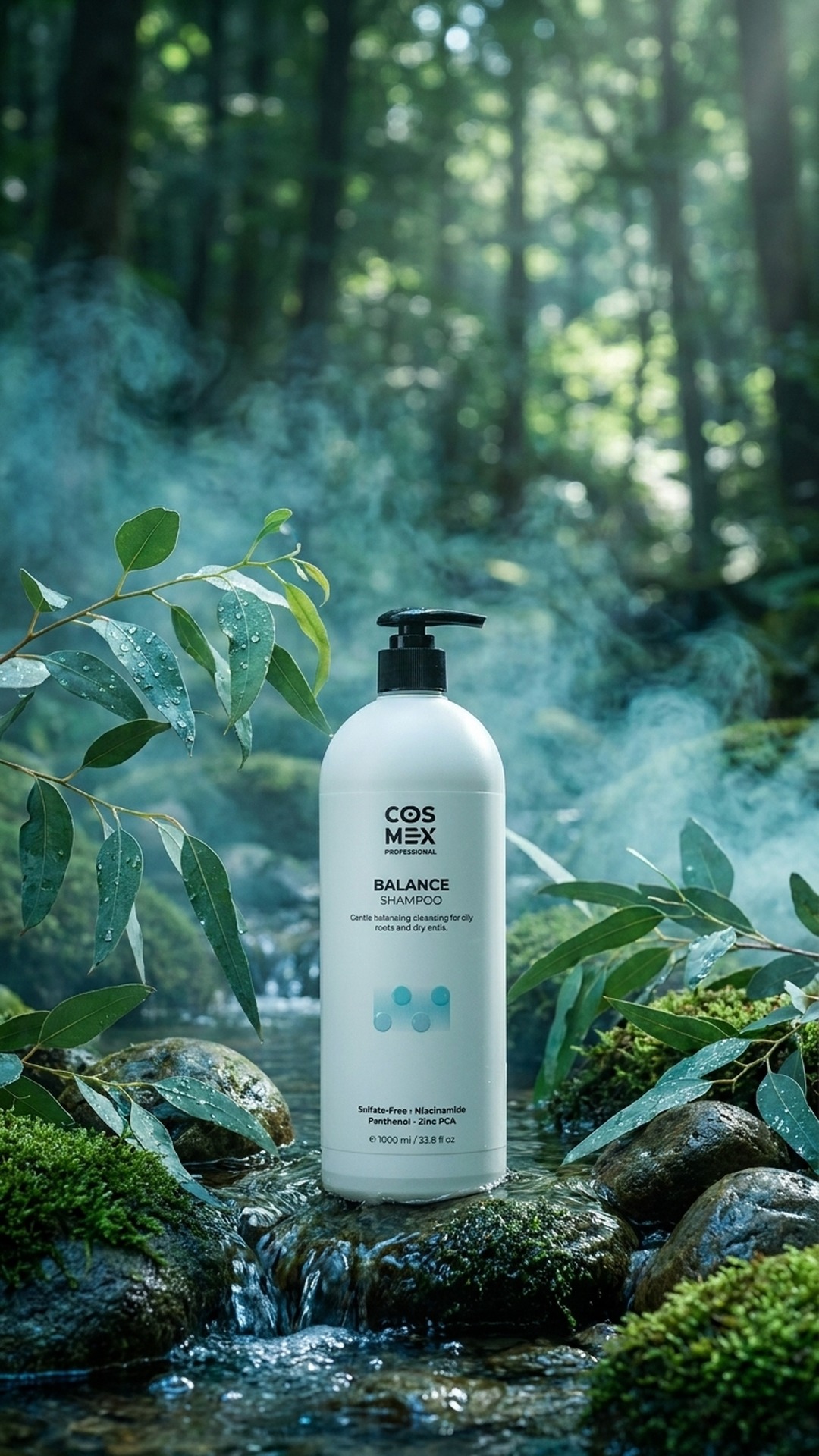
We developed the Balance line specifically for this hair type — a sulphate-free, balancing shampoo made in-house in Almaty. The formula is designed to cleanse the scalp gently and regulate oiliness without triggering the rebound effect. The sulphate-free base isn't a marketing gimmick; it's a deliberate choice — it's precisely what allows you to step out of the 'wash more, grease faster' loop.
We'll be straight with you: we don't promise 'dry roots for a week' — that's an unrealistic claim, and making it would be dishonest. The realistic goal is different: your hair stays fresh longer, and over time you naturally find yourself needing to wash it less often. Ingredients and pricing are in the Professional catalogue.
One important note about the lengths: Balance handles the roots, but dry ends need a separate step. For that we have the Hydration moisturising range — it works alongside Balance and won't weigh down the roots, because it's applied to the lengths only.
What to do right now: step by step
- Switch your shampoo. Move to the gentle, sulphate-free Balance shampoo and wash your hair regularly but without overdoing it — when it actually needs washing, not pre-emptively.
- Wash correctly. Apply shampoo to the scalp and roots, massaging thoroughly with your fingertips. The lather running down will take care of the lengths — there's no need to scrub them with shampoo separately.
- Conditioner on the lengths only. Apply conditioner and masks from mid-length to the ends, never at the roots. Heavy products at the roots are a direct route to faster greasiness.
- Add moisture for the ends. For dry lengths, bring in the Hydration moisturising range — it covers the second half of the 'oily roots, dry lengths' problem.
- Cut out hot water. Wash your hair with warm or cool water, not scalding hot.
- Give your scalp time. Allow 3–4 weeks for recalibration. It may feel like nothing is changing at first — or even that your hair is getting greasier. That's a normal part of coming out of the rebound cycle.
Common mistakes
- Going for a harsher shampoo to get 'drier' results. This is the direct path into the rebound effect: the more aggressively you degrease, the more oil the scalp produces in response.
- Applying conditioner to the roots. Conditioners and masks belong on the lengths only. On the roots, they weigh the hair down and accelerate greasiness.
- Expecting results after two washes. The scalp needs 3–4 weeks to calm its glands down. Giving up on day three means staying stuck in the cycle.
- Treating dry lengths with the same degreasing approach. Roots and ends are different problems. One harsh shampoo applied all over makes both zones worse.
- Washing with very hot water. Hot water revs up the sebaceous glands — the opposite of what you want.
Who it's for — and where to be cautious
A line designed for oily roots isn't a universal fix for every scalp concern. Where it's particularly well suited:
- Roots get greasy quickly while the lengths are dry — the classic scenario this balancing range was made for.
- Scalp becomes oily after aggressive shampoos — the gentle sulphate-free base helps break out of the rebound cycle.
- You want to wash your hair less often — over time, gentle and consistent cleansing genuinely does push back the 'time to wash' day.
Where it's worth pausing and not trying to solve everything with shampoo:
- Persistent itching, pronounced flaking, or crusting. This may not be simple oiliness — it could be seborrhoeic dermatitis or another scalp condition that calls for a dermatologist, not a new shampoo.
- A sudden change in oiliness alongside hair loss. If your hair is actively shedding at the same time, hormones or nutritional deficiencies may be involved — address the root cause first, then focus on care.
- Allergies or sensitivities. If you're prone to reactions, always check the ingredient list and patch-test any new product carefully.
When shampoo isn't enough
Let's be completely honest: shampoo addresses cleansing and balance — it doesn't treat scalp conditions. If you have persistent itching, painful flaking, inflammation, or a sudden unexplained change in oiliness, that's a reason to see a dermatologist or trichologist, not to try yet another bottle.
The same applies when oiliness comes with active hair loss: this can involve hormones, thyroid issues, iron deficiency, or stress. In those cases, you need a diagnosis and a specialist first, with haircare playing a supporting role. We've covered this in detail in our articles on hair loss and types of alopecia. A balancing shampoo is about scalp freshness and comfort — not treatment — and we say so plainly.
Balance and the Cosmex care system
The balancing range delivers its best results not on its own, but as part of a system:
- Balance shampoo — gentle sulphate-free cleansing for the roots and scalp, without triggering the rebound effect.
- Hydration moisture care — a dedicated treatment for dry ends, to address the second half of the 'oily roots, dry lengths' equation.
- A sulphate-free base across the entire range — to avoid over-drying the scalp and setting off the rebound effect (find out why this matters in our article on sulphate-free shampoo).
Ingredients and pricing are in the Professional catalogue. Oily roots are a common issue for men too — if you're looking for an everyday option, check out our shampoos for men. And if you want to understand what haircare actually does and why 'shiny doesn't mean healthy', take a look at our article on hair structure.