The scalp microbiome might sound like another piece of marketing jargon, but there's real biology behind it. About one million microorganisms — bacteria, yeasts, and fungi — live on every square centimetre of the scalp. Together they form an ecosystem that either protects the scalp or undermines it. A healthy microbiome means a calm scalp, healthy follicles, and no dandruff. A disrupted microbiome means the opposite of all that. Let's break down what it is, how to support it, and which actives in shampoos actually make a difference.
Quick summary if you're short on time
- The scalp microbiome is a community of bacteria (Cutibacterium, Staphylococcus, Corynebacterium) and fungi (Malassezia) that naturally inhabit the scalp.
- When the balance is disrupted: Malassezia overgrows → dandruff and seborrhoeic dermatitis; Staphylococcus overgrows → itching and follicle inflammation.
- Balance is disrupted by: harsh shampoos (SLS), colouring, antibacterial products, stress, and systemic antibiotics.
- Balance is restored by: mild surfactants, prebiotics (inulin), probiotics (bacterial lysates), piroctone olamine, zinc pyrithione.
- This is maintenance, not treatment. Pronounced seborrhoeic dermatitis requires a dermatologist.
What lives on the scalp
The scalp microbiome has been widely studied, particularly since the 2010s, when 16S rRNA sequencing became available. According to major research (Sanmiguel and Grice, 2015; Park, Yang et al.):
Bacteria
- Cutibacterium acnes (formerly Propionibacterium) — dominates in sebaceous gland-rich areas. It feeds on sebum and, under normal conditions, protects against pathogens. When sebum is excessive, it overgrows and causes inflammation.
- Staphylococcus epidermidis — a common commensal that produces antimicrobial peptides protecting against Staphylococcus aureus. In balance, it's beneficial; in excess, it becomes an antagonist.
- Corynebacterium — helps stabilise skin pH.
- Staphylococcus aureus — an opportunistic pathogen that can cause folliculitis and inflammation.
Fungi
- Malassezia globosa and M. restricta — the primary yeasts of the scalp. They feed on sebum triglycerides and release free fatty acids that, in excess, trigger an inflammatory response → dandruff and seborrhoeic dermatitis.
Balance matters more than quantity
A healthy scalp is about balance, not «cleanliness». A completely microbe-free scalp (after aggressive antiseptic use) is worse than a moderate microbial flora, because nature abhors a vacuum — the void gets filled by pathogens.
What disrupts the balance
- Strong surfactants (SLS, SLES) — each wash strips not just sebum but the microbiome too. After shampooing, the niche repopulates, and not always with the right organisms.
- Colouring and bleaching — the alkaline environment plus hydrogen peroxide severely disrupts the microflora. Recovery takes 2–3 weeks.
- Antibacterial shampoos used without cause — they wipe out commensals without distinguishing beneficial from harmful organisms.
- Washing too frequently — daily washing means the microbiome doesn't have time to recover.
- Stress — cortisol drives sebaceous glands into overdrive, shifting the balance towards Malassezia.
- Systemic antibiotics — disrupt the microbiota throughout the body, including the scalp.
- Hard water — high pH suppresses lactic acid-producing commensals.
Signs of a disrupted microbiome
- Dandruff — the main indicator of Malassezia overgrowth. Read more in how to get rid of dandruff.
- Scalp itching without visible flaking — often a sign of excess Staphylococcus.
- Seborrhoeic dermatitis — large yellow-grey crusts with a pronounced inflammatory response.
- Folliculitis — small, painful nodules around hair follicles.
- Skin that reacts to every new product — the barrier is weakened and the microflora is unstable.
- Scalp odour even after washing — byproducts of yeast and bacterial metabolism.
What restores the microbiome
Prebiotics
Inulin — a soluble fibre derived from chicory root. On the scalp, it acts as «food for the good guys» — supporting the growth of commensal lactobacilli and preventing pathogens from taking over. Read more in the article on scalp prebiotics.
Alpha-glucans — feed commensals and gently stimulate their growth.
Biotin — supports normal skin metabolism; see biotin for hair.
Probiotics
Cosmetics use bacterial lysates (Bifida Ferment Lysate, Lactobacillus Ferment Lysate) — fragments of broken-down lacto- and bifidobacteria cells. Live bacteria don't survive in a shampoo formula, but their metabolic byproducts (short-chain fatty acids, antimicrobial peptides) remain active on the skin and support the protective barrier.
Zinc pyrithione and piroctone olamine
These are classic actives against Malassezia. Rather than killing everything indiscriminately, they selectively suppress excessive yeast growth and restore balance. Read more in piroctone olamine for dandruff.
Sebum regulators
Niacinamide (B3) — reduces sebum production and normalises conditions for the microbiome. See niacinamide for the scalp.
Salicylic acid at low concentrations — gently exfoliates and unclogs follicles. See salicylic acid for the scalp.
Mild surfactants
Sulphate-free is the foundation. Coco-Glucoside, Cocamidopropyl Betaine, amino acid-based surfactants — they cleanse without «sterilising» the scalp. Read more in sulphate-free shampoo.
What does NOT restore the microbiome
- Strong antibacterial shampoos — they strip everything indiscriminately.
- Weekly scrubs on an already compromised scalp — unnecessary stress.
- «Natural cosmetics» without understanding the formula — essential oils at high concentrations can be antimicrobial and disrupt the balance just as much.
- Skipping washing entirely «so the scalp can regulate itself» — a myth. Without washing, sebum accumulates and Malassezia overgrows even faster.
Microbiome restoration programme
Step 1: remove the triggers
- Switch from an SLS shampoo to a mild, sulphate-free formula.
- Move to warm water instead of hot.
- Reduce washing frequency to 2–3 times a week.
- Stop using antibacterial shampoos unless you have a specific diagnosis.
Step 2: introduce microbiome-targeted actives
- A shampoo with prebiotics + probiotics — the foundation.
- For dandruff — a 4–8 week course with piroctone olamine, followed by maintenance.
- Niacinamide in a leave-on product — normalises sebum production.
Step 3: calm the scalp
- A conditioner free of sulphates and high concentrations of silicones, with minimal fragrance.
- Once a week — a gentle mask with Panthenol and allantoin.
Step 4: be patient
- The microbiome takes 6–12 weeks to recover. Not one week.
- Visible improvement in dandruff — around weeks 4–6.
- Full normalisation — at 3–4 months.
When to see a doctor
The microbiome is a functional condition. If there are signs of a specific disease, you need a dermatologist:
- Pronounced seborrhoeic dermatitis with heavy crusting.
- Scalp psoriasis (plaques with silvery scales).
- Fungal infection with patchy hair loss.
- Purulent folliculitis with pain and fever.
Cosmetics maintain balance. Doctors treat disease.
What Cosmex offers for scalp microbiome care
- Cosmex OverDose OverDerm ScalpBiome™ — a Shampoo + Conditioner + Mask line for the microbiome: prebiotics (inulin), probiotics (bacterial lysates), mild surfactants. A restorative programme.
- Cosmex OverDose OverScalp SebaBalance™ — an anti-dandruff line with piroctone olamine. For pronounced dandruff — use as a 4–8 week course.
- Cosmex Anti-Dandruff Shampoo — for the active phase of dandruff.
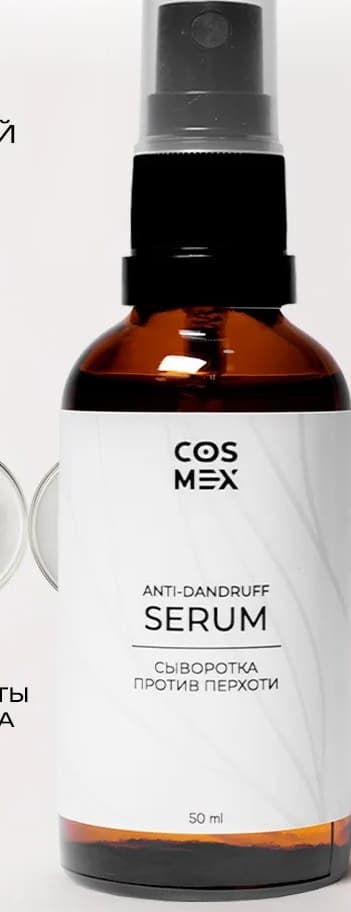
- Cosmex Anti-dandruff serum — a concentrated serum with a spray applicator for targeted scalp treatment.
How to combine programmes: for active dandruff, start with SebaBalance for 4–6 weeks, then transition to ScalpBiome to maintain balance.
Common myths
- «The microbiome is just marketing.» No — it's real biology that has been studied since the 1980s and extensively so since the 2010s. The scalp hosts a microbial community much like the gut, operating on the same principles.
- «The cleaner, the healthier.» The opposite is true. A completely «sterile» scalp is a vulnerable one.
- «Probiotics in shampoo means live bacteria in a bottle.» They don't survive in cosmetic formulations. What's in the formula are lysates and metabolites — and they do work.
- «If you have dandruff, wash your hair more often.» Not necessarily. Dandruff is addressed by specific actives (piroctone olamine, zinc pyrithione), not by washing frequency.
In short: the scalp microbiome is a manageable ecosystem. The goal isn't to sterilise it or overwhelm it — it's to maintain balance with mild surfactants, prebiotics, and targeted anti-Malassezia actives when needed.