Your hair looks dull, won't hold a style, gets greasy at the roots by evening, and your favourite mask seems to have 'stopped working'? Before you overhaul your entire routine and blame your products, check one simple thing — buildup. Over time, a layer of residue settles on your hair and scalp that a regular gentle shampoo can't fully remove. And as long as it's there, no amount of nourishing product will get through. The fix is deep cleansing — a detox. Let's break it down plainly: what exactly accumulates, what a detox shampoo actually is, how often to use it without drying your hair out, and how to work it into your routine without making things worse.
The short version, if you're in a hurry
- Over time, buildup accumulates on hair: silicones, hard water minerals, styling product residue, excess sebum. A gentle shampoo doesn't fully remove it.
- This layer weighs hair down, kills shine, and blocks nourishing ingredients from penetrating — hence the feeling that 'the mask has stopped working'.
- A detox shampoo is a 'deep clean': it periodically strips away buildup completely. It's not an everyday product.
- Frequency depends on your situation: hard water — once a week; heavy styling or silicone use — every 1–2 weeks; average use — 1–2 times a month.
- Deep cleansing is more powerful than regular washing, so always follow it with moisture or a mask — otherwise you risk drying your hair out.
- Detox is a treatment and a tool, not a replacement for your everyday gentle shampoo.
Now, the details.
What actually builds up on your hair
Hair isn't an inert strand — it's a porous surface covered in cuticle scales that readily traps everything it comes into contact with. Over weeks, a layer accumulates on both the hair and scalp that a regular gentle shampoo only partially removes:
- Silicones from leave-in products, masks, and drugstore brands. They deliver instant smoothness, but insoluble silicones gradually form a film that can't be rinsed away with water or a gentle surfactant (more on this in our article about silicones for hair).
- Hard water minerals — calcium and iron. They deposit on the hair shaft, leaving it dull, stiff, and dry to the touch. Water in Almaty and many other cities is hard, so this affects nearly everyone.
- Styling product residue — hairsprays, mousses, gels, dry shampoo. These build up at the roots and along the length in layers.
- Excess sebum and sweat at the roots — especially if your scalp tends to get oily.
Each layer on its own seems harmless. Together, they form a coating that weighs hair down, kills shine, and physically blocks nourishing ingredients from absorbing. That's when the misleading feeling sets in — that 'the mask stopped working' or 'they changed the formula'. In reality, the products are exactly the same; the actives simply can't penetrate through the layer of buildup. It's like applying moisturiser over a film of plastic wrap — you're applying it, but nothing is getting through.
What a detox shampoo is and how it differs
A deep-cleansing (detox) shampoo is a product with stronger cleansing power that periodically strips accumulated buildup completely. Think of it as a deep clean for your hair: a regular shampoo is your daily tidy-up, while a detox is when you wash the windows and move the furniture.
The difference isn't that detox is 'better' than your regular shampoo — it's that it has a different job. An everyday gentle (ideally sulfate-free) shampoo cleanses without compromising the scalp's protective barrier. A detox is specifically designed to dissolve and flush out what has accumulated — which is why it's more powerful, and exactly why you can't use it every day: used constantly, it strips away not just buildup but also the essential lipids your scalp needs, prompting dryness, tightness, or the opposite — overproduction of oil (the so-called 'rebound effect').
The key word here is periodically. A detox works precisely as an accent within your routine, not as its foundation.
How often to deep-cleanse
There's no single universal answer — frequency depends on how quickly buildup accumulates for you. Some guidelines:
- Hard water (Almaty and most cities) — once a week: mineral deposits form constantly and need to be removed regularly.
- Heavy silicone and styling product use — every 1–2 weeks.
- A typical routine without heavy styling and with filtered water — 1–2 times a month is plenty.
How do you know it's time? Your hair will tell you: it looks dull, tangles more easily, gets greasy at the roots faster, and your usual products seem to have lost their effect. That's your cue — buildup has accumulated. And conversely: if your scalp has become dry and tight, you've overdone it — stretch out the interval.
Why a mask works best right after a detox
There's a welcome bonus that many people overlook. After a deep cleanse, hair becomes a blank slate: the cuticles are free of buildup, the scalp's pores aren't clogged, and the surface is at its most receptive. It's the best moment in your entire routine to give your hair something nourishing.
That's why keratin treatment or a rich nourishing mask (Keratin) works especially well immediately after a detox: the actives absorb without obstruction and bond better than they would to hair weighed down with buildup. In effect, the detox opens the door — and the mask walks in. On its own, a detox is only half the job: it cleanses, but it doesn't replenish. That's what the next step is for.
How to deep-cleanse without drying your hair out: step by step
Deep cleansing is more powerful than your everyday wash, so technique matters more than you might think. Here's how to do it:
- Use the detox shampoo as a course treatment and when needed, not instead of your everyday shampoo. It's an on-demand tool, not a new daily habit.
- Work it through the scalp and along the length, massaging with the pads of your fingers — not your nails. Buildup is removed through contact between the active formula and the surface, not through friction; give it a couple of minutes to work.
- Rinse thoroughly. If your hair was heavily coated in silicones, you may need to lather twice — product that isn't fully rinsed out feels just as heavy as the buildup itself.
- Follow immediately with moisture. Always apply a hydrating mask or conditioner along the length (Hydration). This isn't optional — it's part of the treatment: you've opened up the hair, now you need to nourish it.
- Between detoxes, cleanse gently — with a sulfate-free shampoo that won't dry out the scalp or trigger a rebound effect.
Common mistakes
- Using the detox shampoo every day. The most frequent mistake. A powerful cleansing product used daily is a fast track to dryness, tightness, and the opposite of what you want — a scalp that gets oily even faster.
- Deep-cleansing and skipping the moisture step. You've cleaned everything out and left the hair bare. Without a mask or conditioner to follow, it becomes porous and dry. Cleansing and moisturising are always a pair in a detox routine.
- Scrubbing the scalp with nails. It feels like it'll 'clean better', but in practice it irritates the scalp and doesn't help remove buildup. Use the pads of your fingers.
- Expecting full results from a single wash when buildup is heavy. If silicones have been building up for a while, one wash may not remove everything — hence the rule of lathering twice.
- Confusing detox with treatment. A detox restores cleanliness and your hair's responsiveness to care, but it doesn't treat hair loss or 'revive' damaged hair — it's hygiene, not therapy.
Who benefits most from a detox — and who should be cautious
Where deep cleansing is particularly worthwhile:
- Hard water — mineral buildup affects everyone who washes with it, so regular detoxing is practically essential.
- Fans of styling products and leave-ins — hairsprays, mousses, and silicones all call for a periodic deep clean.
- The feeling that your routine has stopped working — this is often a classic sign of accumulated buildup.
- Oily roots — a detox helps reset excess sebum, though without going overboard.
And where you need to be careful:
- Very dry, porous, or damaged hair — detox less frequently and always follow with intensive moisture, or you risk stripping the hair further.
- Sensitive scalps prone to dryness — stretch out the intervals and pay attention to how your scalp responds.
- Immediately after colouring — deep cleansing can accelerate colour fade; it's better to wait.
Honestly: detox is a course of treatment, not a habit
Let's be straight about this to avoid disappointment. A detox shampoo is a powerful and useful tool — but precisely because it's powerful, it's easy to turn from an ally into a problem. It's a product for periodic use and when needed, not for every day. Its strength lies in that periodicity: removing what's built up, opening hair up to nourishment, and then stepping aside for moisture. If you use it constantly, you'll end up with exactly what you were trying to escape — dryness, dullness, and a scalp that compensates by producing even more oil.
One more honest note: a detox doesn't solve problems that go deeper than hygiene. If your hair is losing its shine and breaking not because of buildup but because of damage or hair loss — that's a different story, one that calls for targeted care and, if necessary, a specialist. Detox is about cleanliness and hair's receptiveness to care, not about treatment.
The Detox line from Cosmex and the complete care system
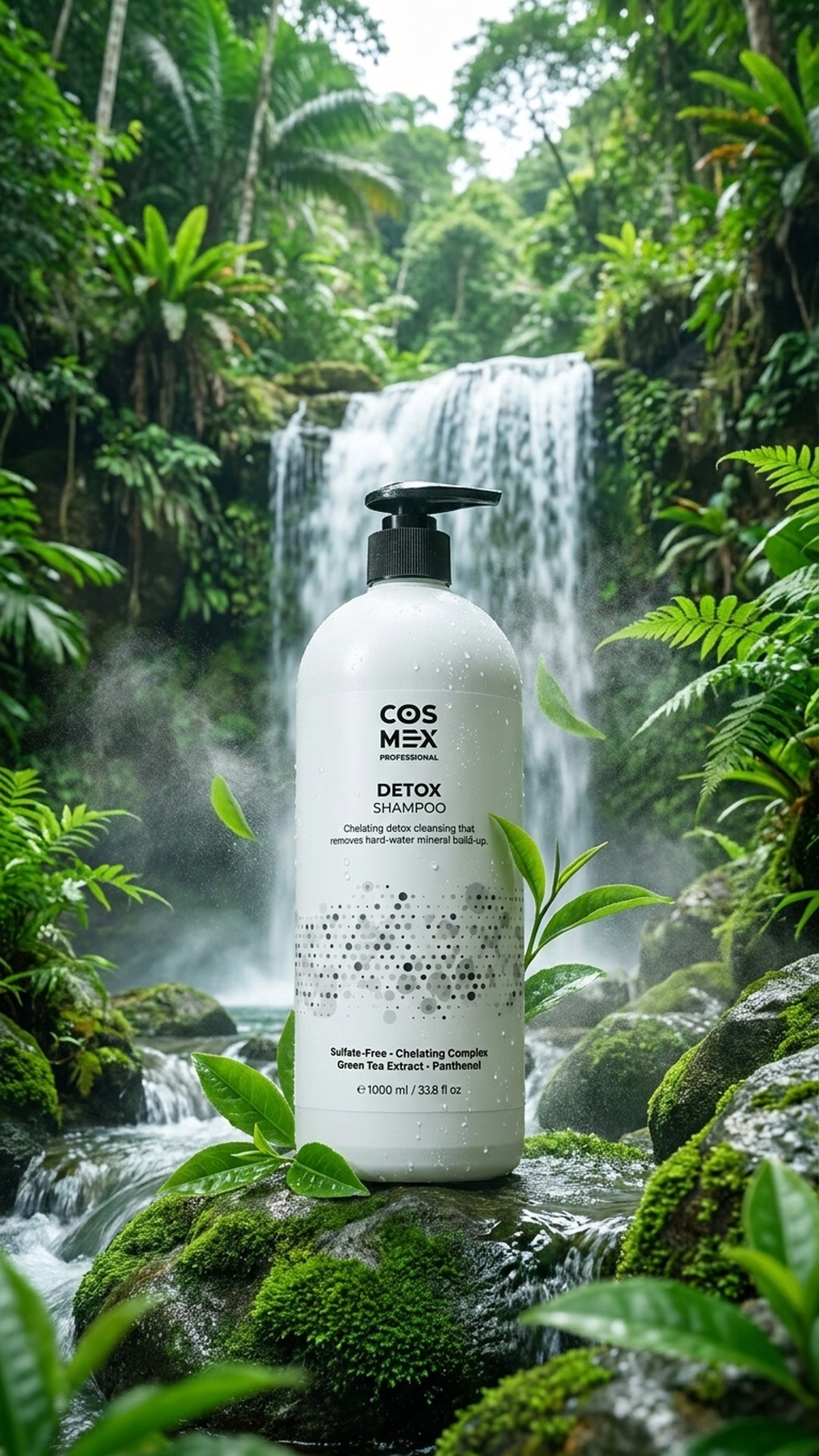
For periodic deep cleansing, we created the Detox line — a shampoo manufactured in-house in Almaty. It removes buildup from silicones, styling products, and hard water, but is formulated thoughtfully so it doesn't 'scorch' the scalp. We'll be upfront: this is a product for a course of treatment, not everyday use.
A detox delivers its best results not on its own, but as part of a system — cleansing always paired with restoring moisture:
- Detox Detox — removes accumulated buildup, restores cleanliness and shine, opens hair up to care.
- Mask Keratin — right after the detox: hair is more receptive than at any other time, and actives absorb without obstruction.
- Moisture Hydration — an essential follow-up step, so you don't leave freshly cleansed hair bare.
- A sulfate-free shampoo for everyday use — gentle daily cleansing that won't dry out your scalp between detoxes (why this matters is covered in our article on sulfate-free shampoo).
How often you should wash your hair in general is covered in a separate article. The full range with ingredients and pricing is in the Professional catalogue.