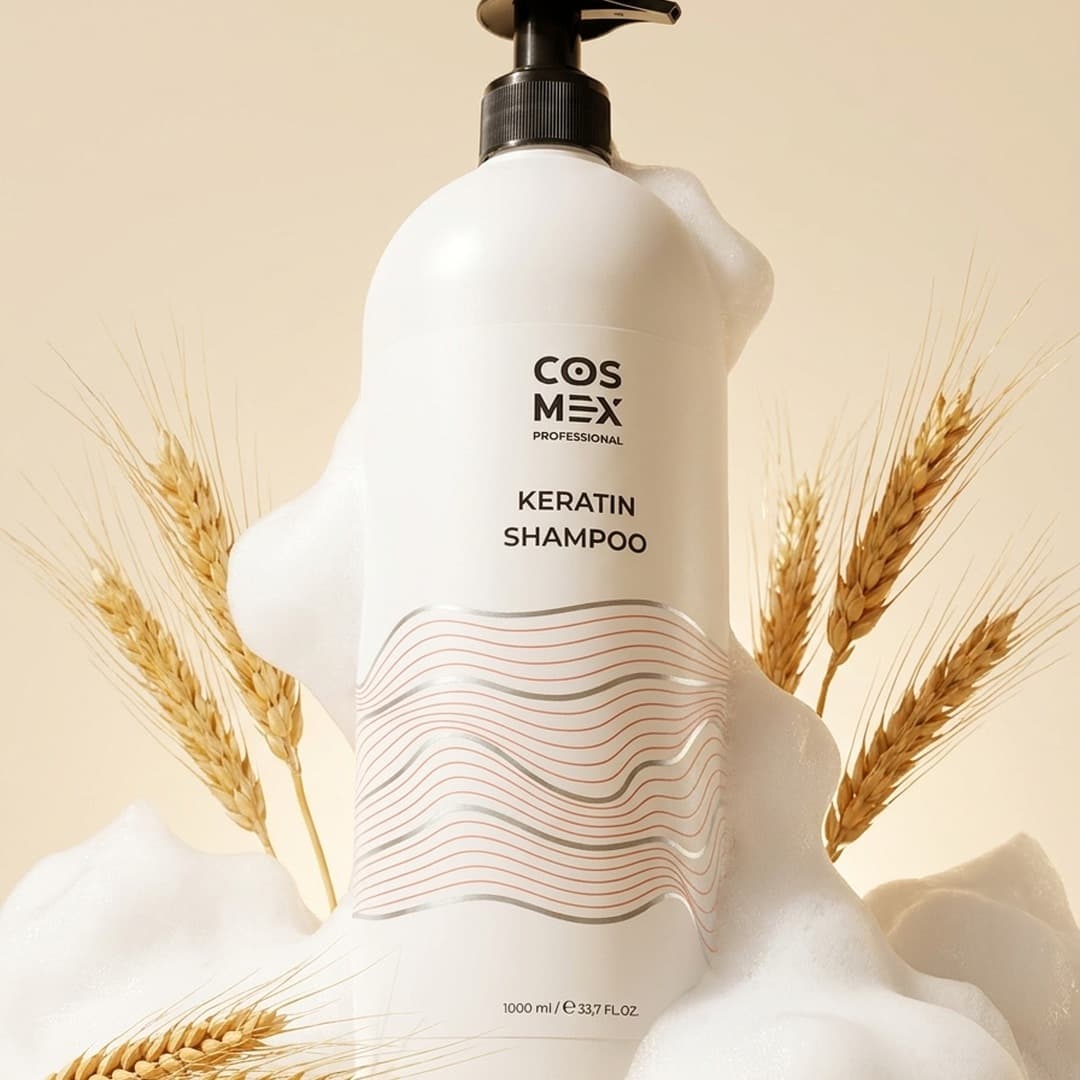
If you spot "silk proteins" (INCI name: Hydrolyzed Silk) on the label of a shampoo or mask, you're looking at one of the most pleasant conditioning proteins in haircare. It doesn't make grand promises — it simply delivers a straightforward result: hair feels softer, smoother, and easier to detangle. Let's take an honest look at what this ingredient actually does, what you shouldn't expect from it, and which Cosmex products genuinely contain it.
What It Is and How It Works
Silk is a protein. In its raw form, it's too large to interact meaningfully with the hair shaft, so cosmetics use hydrolyzed silk — the same protein broken down into short peptides and amino acids. Because these fragments are small, they distribute across the hair surface and work in the following ways:
- Smoothing the surface. Hair is covered in scales (the cuticle). When they're raised, hair feels rough, tangles easily, and looks dull. Silk peptides help flatten that surface, which is where the smoothness and shine come from.
- Retaining moisture. The protein is hygroscopic — it attracts and holds water close to the hair shaft. This is why hair feels not dry and brittle, but soft and alive.
- Reducing friction. A smoother surface catches less on neighboring strands and on the comb — less frizz, easier detangling, neater styling.
The key thing about this ingredient is that it's a lightweight protein. It improves the hair surface without leaving a heavy film or weighing the style down. That makes it suitable even for fine hair, which heavy oils and silicones can make look greasy almost instantly.
Which Cosmex Products Contain It
We use Hydrolyzed Silk in three lines:
- Hydration — our moisturizing line. Here, silk works in natural synergy with the focus on softness and moisture retention: ideal for dry, frizzy, or dehydrated hair.
- Protein — a line centered on protein strengthening. Silk here serves as one of the lighter conditioning proteins, adding smoothness without overloading the hair.
- Black Edition — our premium line, where silk is part of a carefully considered nourishing formula.
Always check the packaging and product page for the exact formula of any specific product: the same active ingredient works differently in a shampoo, conditioner, or mask because contact time and the surrounding formula differ.
If you want a deeper understanding of how active ingredients in haircare work in general, take a look at our overview of Cosmex actives, and for a closer look at what these proteins actually act on, see our article on hair structure.
Getting the Most Out of It
A few simple things to make sure the silk actually works rather than just washing away:
- Don't confuse shampoo and treatment. In a shampoo, any conditioning protein is in contact with hair for only a few seconds and is almost entirely rinsed off. You get the most from silk in conditioners and masks — products that stay on the hair longer.
- Apply to the lengths and ends, staying away from the roots. The lengths are what suffer from dryness and friction; roots generally don't need the extra conditioning.
- Give a mask time to work. A couple of minutes is enough for the peptides to distribute evenly. Leaving it on for half an hour doesn't help — protein doesn't "absorb deeper" with extra waiting time.
- This is a cumulative, not a one-off effect. The smoothness silk delivers is about consistency. A single use gives a pleasant result; a lasting improvement comes from regular care.
Honest Expectations: What It Won't Do
To avoid any disappointment:
- Silk doesn't heal or restore hair from within. It works on the surface of hair that has already grown. It can make the structure look and feel smoother, but no ingredient can turn severely damaged hair into new hair.
- It has no effect on growth, density, or shedding. If your hair is falling out, thinning, or you're dealing with persistent dandruff or scalp irritation, that's not something silk can address. The cause is usually internal — hormones, nutritional deficiencies, scalp condition — and that's a reason to see a trichologist or dermatologist. Haircare products are for maintenance and support, not treatment; they don't treat medical conditions.
- Silk is not a substitute for structural repair. If your hair is porous and brittle after bleaching or frequent heat styling, silk will add smoothness, but rebuilding the structure is better handled by other proteins. We cover that in a separate article on keratin hair restoration.
Quick Myth Check
- "Silk proteins weigh hair down." It's actually the opposite — this is precisely the lightweight protein you reach for when you want smoothness without any heaviness.
- "Silk vs. keratin — which is better?" They're not competing. Keratin focuses more on structural repair; silk is about softness, smoothness, and moisture. In a well-made formula, they work together perfectly well.
- "More protein means better results." No. Good haircare requires a balance of proteins and moisture; overloading on protein actually makes hair stiff. That's why silk is added at the amount specified in the formula — not "as much as possible."
The bottom line is straightforward: Hydrolyzed Silk is a reliable workhorse for softness, smoothness, and moisture retention that won't weigh hair down. It's not a miracle ingredient, but it's an honest, pleasant one that makes a noticeable difference in how hair behaves with regular care.