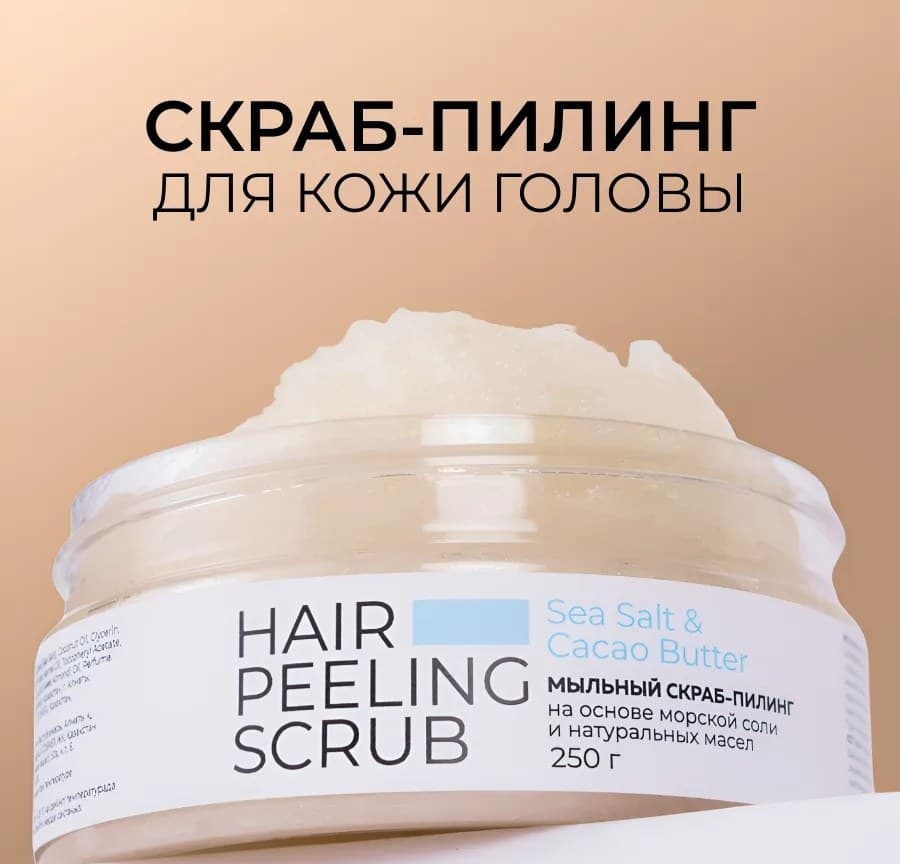
How to use a scalp scrub: apply a walnut-sized amount to damp scalp before shampooing, distribute it along your partings, massage gently with your fingertips in circular motions for 2–3 minutes without pressing hard, rinse thoroughly with warm water, then wash your hair with a mild sulfate-free shampoo. Frequency: once a week for oily scalp, once every 10–14 days for normal scalp.
A scalp scrub is one of the most underrated steps in haircare. Most people wash their hair and assume the scalp gets clean in the process. In reality, it doesn't: between the strands, sebum, dead skin cells, silicones, and styling products accumulate — and within a month that buildup forms a dense film that interferes with normal follicle function. A scrub removes that film in just a minute. Here's who needs it, how often, and which type to choose.
Quick summary
- A scalp scrub provides mechanical and/or chemical exfoliation of the scalp. It removes the film of sebum, dead cells, and styling product residue.
- It's useful for almost anyone who uses styling products, colors their hair, or lives in a hard water area — especially those with an oily scalp or roots that get greasy quickly.
- Frequency: once every 7–14 days for normal scalp, up to once a week for oily scalp, no more frequently for dry or sensitive scalp.
- It does not replace treatment for dandruff or seborrhea. If you have crusting and itching, see a dermatologist first.
Why your scalp needs a scrub
The scalp's epidermis renews itself every 28–35 days — just like facial skin. Dead cells don't shed on their own; they stay on the surface, mix with sebum, and form a compact layer. On top of that, the following accumulate:
- Silicones from shampoos and masks.
- Waxes and polymers from styling products — mousse, hairspray, gel.
- Minerals from hard water (calcium, magnesium).
- Dust and environmental pollutants.
Once this layer builds up, several things happen:
- Follicles struggle to function. Blocked follicle openings reduce oxygen exchange, causing hair to grow in thinner.
- Sebum accumulates inside the follicle, leading to small, tender bumps (folliculitis).
- Shampoo only works on the surface and never actually reaches the scalp.
- Treatments can't absorb — masks and serums sit on top of the film rather than working on the skin itself.
- Roots get greasy faster — because sebum can't escape, it builds up in the follicle and then releases all at once.
A scrub removes that film. After 4–6 weeks of regular use, the scalp stops getting oily by the end of the day, follicles function more freely, and shampoo lathers and cleanses more effectively.
Types of scalp scrubs
Mechanical
Contains abrasive particles: salt, sugar, ground fruit pits, or synthetic beads. Removes buildup physically — the particles catch dead skin cells and carry them away.
- Salt-based — gentle and hypoallergenic, though salt can sting on broken skin.
- Sugar-based — granules dissolve as you massage, so the scrub becomes softer as you go. Suitable for sensitive scalps.
- Pit-based — the most intensive option, best for very oily scalps and heavy buildup.
Chemical (enzyme or acid-based)
Contains no abrasive particles. Works through acids (salicylic, glycolic, lactic) or enzymes (papain, bromelain), which dissolve the bonds between dead cells. The result: the skin sheds its built-up layer on its own.
- Salicylic acid — oil-soluble, penetrates the follicle, works exceptionally well for oily scalps and clogged pores. More detail: salicylic acid for the scalp.
- AHA acids (glycolic, lactic) — water-soluble, work on the surface. Milder.
- Enzymes — the gentlest option, suitable for sensitive scalps.
Combined
Pairs a mild physical abrasive (salt, sugar) with a low-concentration acid. Dual action with minimal irritation. This is the most versatile format.
Who should use a scalp scrub
- Oily scalp and quickly greasy roots. A scrub relieves follicle congestion and helps regulate sebum production.
- Daily styling product users. Waxes, sprays, and gels build up over time — a scrub removes them.
- Color-treated hair. Between coloring sessions, dye residue and ammonia remain on the scalp. A scrub removes them and prolongs the freshness of your color.
- Hard water areas. Calcium and magnesium leave deposits; a scrub removes them.
- "My shampoo doesn't lather the way it used to." This is one sign of accumulated buildup. A scrub paired with a detox shampoo solves the problem.
- Sulfate-free shampoo users. These formulas are milder and leave more residue — a scrub once every 2 weeks is a must.
Who should skip a scalp scrub
- Dry, fine, or sensitive scalp with no oily roots. A scrub will only dry it out further — a gentle sulfate-free shampoo with Panthenol is a better choice.
- Active seborrheic dermatitis, eczema, or scalp psoriasis. See a dermatologist first — using a scrub on inflamed skin makes irritation worse.
- Freshly colored hair (< 48 hours). A scrub strips pigment; wait before using one.
- Fresh micro-damage (cuts, scratches, sore patches) — a scrub will aggravate them.
- Very infrequent washing (once a week or less). Establish a regular washing routine first.
How to use it correctly
Step 1: Preparation
- Apply to damp hair, before your main wash, in the shower.
- Don't shampoo before the scrub — it will undo the effects of the exfoliation.
Step 2: Application
- Take a walnut-sized amount for medium-length hair. More is not necessary.
- Apply along your partings directly to the scalp, not along the length of your hair.
- Work from the nape toward the forehead, parting the hair with your fingers as you go.
Step 3: Massage
- 2–3 minutes of circular movements using your fingertips.
- No pressing or scrubbing! A scrub works through gentle gliding, not aggressive scraping.
- Don't use your nails — this damages both the hair cuticle and the skin.
Step 4: Rinsing
- Rinse with warm water until completely clean — no salt or granule residue left in the hair.
- Follow with a sulfate-free shampoo (a mild one), not an aggressive detox formula.
Step 5: Aftercare
- Apply conditioner or a mask to the lengths only, not the roots. The scalp is more active after exfoliation and doesn't need a coating.
- A serum with Panthenol or niacinamide will help calm the scalp.
How often to scrub
- Oily scalp — once a week.
- Normal scalp — once every 10–14 days.
- Dry or sensitive scalp — once every 3–4 weeks, using only a gentle enzyme scrub.
- Daily styling product use — once a week without exception.
What to avoid
- Don't use a face or body scrub on your scalp. The granules are coarser and the formula isn't designed for the scalp's skin barrier.
- Don't combine a scrub and a detox shampoo in the same wash. That's a double hit. Use the scrub first, then the detox shampoo 3–4 days later — or alternate them.
- Don't scrub before coloring your hair. Your scalp will be more reactive and the color will absorb more intensely, causing greater irritation. Scrub a week before coloring and again two weeks after.
- Don't use a scrub on an active dandruff flare. It will worsen flaking. Complete a course of piroctone olamine or ketoconazole first, then introduce the scrub.
What Cosmex offers
- Cosmex Scalp Scrub — a gentle salt-based scrub with a blend of plant extracts. Suitable for most scalp types, except acutely sensitive ones.
Paired with sulfate-free shampoos and Trichology scalp care, it forms a complete program for healthy follicles.
Common mistakes
- "A scrub replaces shampoo." No. The scrub goes before the shampoo, not instead of it.
- "The harder I scrub, the cleaner it gets." The opposite is true. Aggressive rubbing damages the skin and the hair cuticle.
- "A scrub makes hair grow faster." Indirectly — yes: it relieves follicle congestion and improves oxygen access. But it doesn't directly "grow" hair, just like any other cosmetic product.
- "Scrubs are for oily scalps — mine is dry, so I don't need one." If you use styling products or color your hair, you still need one — just less frequently and with a gentler formula.
In short: a scalp scrub is a "deep clean" done once every one to two weeks. Ten minutes in the shower, and your follicles are back to working like new.